

- Food Service and Seafood Wholesale Specialists
- Client Login
- 61 8 9434 1200
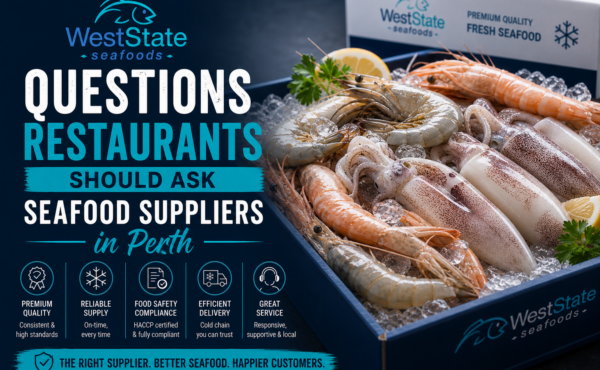
Choosing the right seafood suppliers is one of the most important decisions a restaurant, cafe, hotel, pub, hospital, or aged care facility can make.
Whether you run a busy bistro in Fremantle or a high-volume aged care kitchen in the suburbs, your restaurant food supply chain directly affects quality, safety, and profitability.
Before you sign any agreement, here are the seven essential questions every restaurant owner in Perth should ask.
Restaurant seafood is not a commodity you can afford to get wrong. Quality, consistency and pricing all play a direct role in your menu performance and guest satisfaction.
A weak supply chain leads to costly substitutions, health risks, and reputational damage.
Great produce does not guarantee great supply. Operators need a partner who understands the demands of high-volume restaurant food supply.
Working with trusted food suppliers like Weststate Seafoods, who understand the commercial kitchen environment will help you maintain consistent plate quality, manage food costs, and respond quickly when seasons or stocks shift.
Diners and procurement officers alike want to know where their food originates. Ask your supplier to provide clear documentation of species origin, whether the catch is wild or farmed, and which fisheries or aquaculture operations they source from.
Ask whether the supplier can provide traceability documentation. This is particularly important for hospitals and aged care facilities managing compliance requirements.
Key questions to ask:
Ask your supplier to explain their cold chain process from wharf to delivery. Find out how many days post-catch your restaurant seafood typically is when it arrives, and what their maximum holding period is before dispatch.
A reputable supplier will be transparent about these figures and will have documented cold chain management procedures.
For high-turnover kitchens, daily or twice-weekly deliveries are standard. Confirm the supplier can match your operational cadence without compromise on temperature control.
Restaurant food supply budgets require predictability. Ask your supplier how they structure pricing, whether market-rate fluctuations are passed on daily or quoted weekly, and what bulk pricing thresholds apply.
Large-volume buyers such as hospital kitchens and hotel groups should expect tiered pricing structures.
Understand the difference between market-rate lines and fixed-contract products so you can plan your food cost percentages with confidence.
Late or missed deliveries during a dinner service can cripple a kitchen. Ask for specifics around their delivery run structure, geographic coverage across Perth, and cut-off times for next-day orders.
Find out whether they use their own refrigerated fleet or rely on third-party couriers, and what protocols are in place when a run is delayed.
Any credible supplier should operate under a HACCP-accredited food safety management system.
Ask to see their current accreditation. Supplying to hospitals and aged care, food safety compliance is not optional, it is a licensing and duty-of-care requirement.
Confirm that the supplier’s premises, transport vehicles, and handling procedures all meet Australian food safety standards. Ask specifically how allergen management and cross-contamination risk are controlled across their operation.
Ask your potential supplier whether they can guarantee continuity of supply for your core species throughout the year, including outside peak season. A supplier who runs out of barramundi in March or cannot fill a large event order at short notice is a liability.
Restaurant seafood buyers running high-volume operations should discuss minimum order quantities, lead times for large event orders, and the supplier’s capacity to scale delivery frequency during peak periods.
Bad weather, regulatory closures, and transport issues can all affect availability. What separates a reliable partner from a transactional vendor is how they communicate and resolve these situations.
Ask for a clear escalation process. Find out who your account contact is, how quickly you will be notified of a supply problem, and whether they can suggest or substitute equivalent products at an agreed price point.
A proactive supplier will already have a contingency framework in place.
Not all suppliers are created equal. Watch for these warning signs during your evaluation:
If a supplier is reluctant to answer detailed questions about their operation, treat that as a signal to look elsewhere. The right partner will welcome scrutiny, not deflect it.
Use this checklist when evaluating potential suppliers:
Once you have found the right supplier, here are practical ways to get the most from the relationship:
WestState Seafoods has built its reputation by doing the fundamentals right.
As a specialist in restaurant seafood supply across Perth, we offer a comprehensive range of fresh and frozen products sourced directly from trusted national and international suppliers.
Our cold chain infrastructure, refrigerated delivery fleet, and HACCP-compliant processes give commercial buyers the confidence they need.
WestState Seafoods understands the volume, consistency, and compliance requirements that come with professional food service. Our team provides dedicated account support and proactive communication when supply conditions change.
To find out more about our products and delivery coverage across Perth, visit Weststate Seafoods.
Seafood pricing is driven by seasonal catch volumes, fuel and logistics costs, export demand, and weather events that affect fishing operations.
Restaurants can reduce exposure by adjusting their menus to feature in-season alternatives.
Reputable suppliers maintain relationships with multiple fisheries and can substitute equivalent products when a specific species is unavailable.
For example, if barramundi stocks are low, a reliable partner may offer another alternative at a comparable price point. Always discuss contingency options with your supplier before a shortage occurs, not during one.
The most common mistakes include choosing on price alone without considering reliability, failing to ask about food safety accreditation and not verifying cold chain management processes.
Restaurants that treat their restaurant food supply relationship as purely transactional tend to experience the most disruption during peak periods.
Yes, significantly.
A supplier who delivers consistently on time, provides accurate invoices, communicates proactively about stock changes, and offers flexible order windows reduces the administrative burden on kitchen staff and purchasing managers.
When restaurant seafood arrives at the right time in the right condition, prep schedules run more smoothly, waste decreases, and the team can focus on cooking rather than chasing orders.

If you are looking to buy fresh or frozen seafood of the highest quality, a great food service range including some of the most well-known brands in the hospitality industry, then Weststate Seafoods is the company for you.
12A Coolibah Way, Bibra Lake, WA 6163, Australia
© WestState Seafood 2026 | Privacy Policy | Site by c4 Digital Agency