
- Food Service and Seafood Wholesale Specialists
- Client Login
- 61 8 9434 1200
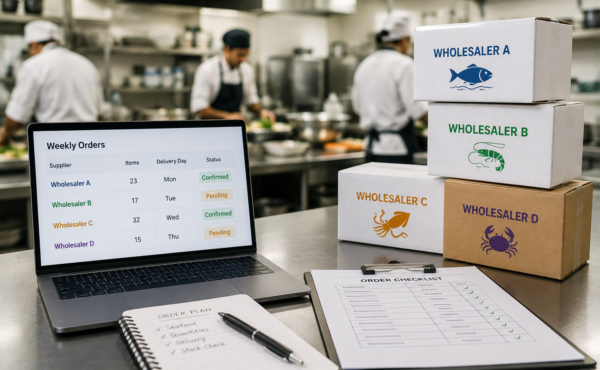
Managing a commercial kitchen in Western Australia is a constant balancing act between maintaining food quality and protecting profit margins. Between roster management, meal preparation, and strict HACCP compliance, head chefs and venue managers often find themselves buried in administrative paperwork late at night.
One of the most significant yet overlooked operational drains on a restaurant is split procurement. Buying from multiple food wholesalers seems like a smart way to cherry-pick low prices, but it quietly erodes your bottom line through hidden overheads.
When kitchen managers order across fragmented supplier networks, procurement costs multiply quickly. Unraveling the true financial impact of split ordering reveals why leaning on one food service supplier for restaurants helps commercial kitchens cut operating costs and reclaim valuable time.
Most venues end up with a network of niche suppliers organically rather than by strategic design. When opening a venue or launching a new seasonal menu, management typically seeks out specialised vendors for each product category:
While sourcing from specialist vendors appears logical, the cumulative operational costs of maintaining five to ten distinct accounts usually outweigh any small unit-price savings.
Managing relationships with multiple food wholesalers introduces invisible frictions that slow down kitchen workflows, drain administrative resources, and trigger costly supply mistakes.
Every additional vendor requires a separate procurement process. Instead of submitting a single weekly order, a chef must spend hours checking stock levels across different inventory sheets, logging into multiple ordering apps, and tracking separate delivery cutoff windows. Learning how to reduce food ordering time requires eliminating this administrative duplication.
When ordering tasks are split across several portals or late-night text lines, human error increases significantly. Mismatched item codes, missed order deadlines, and duplicated line items become frequent headaches. Correcting these errors mid-service wastes management hours and creates emergency stock shortages.
Multiple vendors mean multiple delivery vehicles arriving at your loading dock throughout the day. Receiving shipments from four or five distributors disrupts kitchen prep, forces staff off the line to check invoices, and increases the risk of cold-chain breakdown if deliveries sit unattended.
Tracking inventory across fragmented suppliers complicates stock rotation and invoice reconciliations. Managing varied delivery schedules makes calculating accurate food cost percentages difficult and frequently results in over-ordering, leading to food waste in coolrooms and dry stores.
The financial burden extends straight to the back office. Every delivery docket generates an invoice that accounts payable staff must audit, enter into accounting software, and reconcile against monthly statements. Processing twenty invoices per week instead of four inflates administration costs dramatically over a quarter.
Consolidating purchases with a single, comprehensive distributor converts chaotic procurement routines into an efficient operational workflow. Discovering the benefits of using one food supplier helps hospitality operators streamline supply chains and lower total cost of ownership.
|
Operational Factor |
Multiple Food Wholesalers |
Single Food Service Partner |
|
Weekly Ordering Time |
4 to 8 hours spent across multiple portals | 1 to 2 hours via a consolidated order sheet |
|
Delivery Logistics |
10 to 15 deliveries per week disrupting prep | 2 to 3 organised, consolidated morning drops |
|
Accounts Payable |
Dozens of invoices to match and process | Unified weekly invoice for easy reconciliation |
|
Freight & Minimums |
Multiple delivery fees and minimum order hurdles | Easily meet thresholds for free consolidated delivery |
|
Product Consistency |
Variable quality standards across vendors | Guaranteed standards and consistent seafood availability |
Partnering with a broadline vendor like Weststate Seafoods gives venues access to premium fish products, shellfish, pantry and foodservice staples on a single order run.
Vendor consolidation becomes essential as soon as administrative overhead impacts kitchen profitability or operational focus. A venue should evaluate supplier consolidation if:
Transitioning to one food service supplier for restaurants eliminates unnecessary operational roadblocks, allowing management to focus on customer experience and venue profitability.
The cost of using multiple food wholesalers is not limited to the prices shown on individual invoices. Staff time, ordering errors, delivery coordination, inventory complexity and administration can quietly increase the total cost of procurement.
For restaurants and hospitality businesses, the benefits of using one food supplier can therefore extend well beyond convenience. Consolidating suitable purchases with one food service partner can create a simpler, more predictable ordering process while maintaining access to the products a commercial kitchen needs.
Weststate Seafoods combines seafood expertise with a broader food service range, helping Perth and Western Australian hospitality businesses streamline more of their regular purchasing requirements through one supplier.
When evaluating suppliers, look beyond individual product prices and consider the complete procurement picture: how much time, administration and operational effort does each supplier relationship require? That is where supplier consolidation can deliver its greatest value.
It depends on the restaurant’s needs. One supplier can simplify ordering and administration, while multiple suppliers may be worthwhile for specialist products, unique pricing or specific quality requirements.
Hidden costs include staff ordering time, additional invoices, delivery coordination, stock discrepancies, purchasing errors, emergency orders and the administration required to manage multiple supplier relationships.
One food service supplier can reduce the number of orders, deliveries and invoices that staff need to manage. A broader product range can also simplify procurement and improve purchasing visibility.
A restaurant should consider consolidation when managing multiple suppliers is creating excessive administration, inconsistent deliveries, stock management problems or unnecessary ordering time.
Restaurants can reduce ordering time by standardising stock levels, using regular ordering schedules, maintaining a purchasing checklist or online portal ordering guide and consolidating suitable products with fewer suppliers.

If you are looking to buy fresh or frozen seafood of the highest quality, a great food service range including some of the most well-known brands in the hospitality industry, then Weststate Seafoods is the company for you.
12A Coolibah Way, Bibra Lake, WA 6163, Australia
© WestState Seafood 2026 | Privacy Policy | Site by c4 Digital Agency